Written by Mike Hamilton, CCA & President of Turf Dietitian
According to the National Weather Service, a strong El Nino ocean current will regulate the winter of 2018-19. The National Weather Service forecasts that the winter of 2018-19 will be colder and wetter than the average for the southern states and dryer and colder in northern states. From experience, we know that prolonged cold temperatures, above-average rainfall, and excessively cloudy weather in the South can potentially be disastrous for southern golf courses.
El Niño gets its definition by prolonged warming in the Pacific Ocean sea surface temperatures compared to the average value. Typically, this anomaly happens at irregular intervals of two to seven years and lasts nine months to two years. Experts predict this year’s El Nino will be the strongest in the past 75 years.
The last two El Nino’s (2015 and 1997) were strong, and this year will be no different. The winter of 2015 and 1997 was a conveyor belt for cold fronts and storms, many of which were deadly. The winter of ’97 also led to several Superintendents unfairly losing their jobs. Primarily due to conditions that were out of their control.
During an El Nino year, the southern jet stream is much stronger than it usually would be, and the storm track moves across the southern tier of the U.S.
Temperatures Overall, Winter 2018-2019
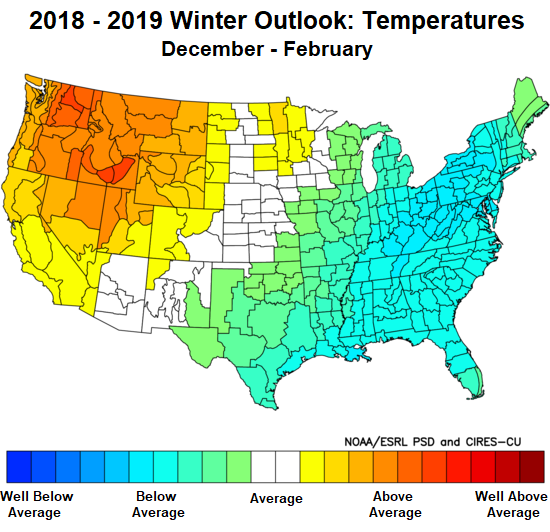
As we look at the winter as a whole (December through February), we expect the final numbers to show below-average temperatures across much of the South.
Precipitation Overall, 2018-2019
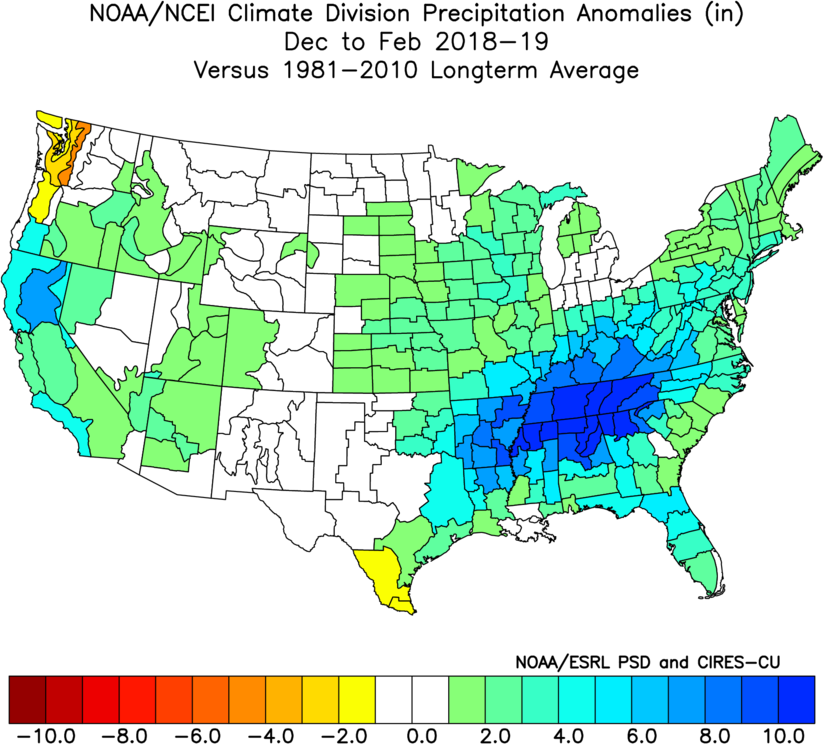
Nearly all past El Niño winters have featured an active storm track across the southern United States. It looks like that pattern will dominate our winter this year as well. Therefore, we expect above-average precipitation from Southern California to Florida and up to the East Coast to Maine, which will likely include a higher threat of severe weather near the Gulf Coast, including Florida.
Forecast Considerations: Strong El Niño with a twist
El Niño is associated with a warming of sea surface temperatures in the tropical regions of the Pacific Ocean, primarily to the west of South America (region highlighted by the oval on the map below). When ocean water temperatures in this region are warmer than average, it impacts weather patterns worldwide, especially during the late fall and winter. As we head into winter, El Niño will likely peak as one of the top two most impactful events since 1950.
Sea surface temperature anomalies, Late August 2018
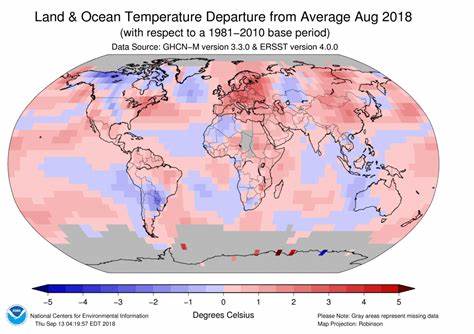 When the warmest water relative to normal (the darkest shades of red) drifts close to the coast of South America, we usually see frigid weather across much of the Southern US, much like what we experienced in 1982-83, 1997-98, and 2015-16.
Another key to the upcoming winter weather is if the El Niño peaks later in the fall and then starts to weaken as we progress through the winter or whether it continues to strengthen during the winter. A strengthening El Niño, rather than a weakening El Niño, during the heart of winter, would likely mean a colder winter for the Southern States.
Managing a Strong El Niño
I’m not trying to be a doomsayer, but considering the expectation of damaging weather, you must be on the defensive. Also, most of the country has had extreme weather conditions this year. Many of the greens I’ve seen this year have shallower roots and a thinner turf canopy. Meaning they are more disease prone than in the past.
The soil trends I witnessed during this summer sample period were slightly alarming. The data suggested that many courses underwent deterioration of soil structure due to higher than average rainfall and higher saturation indexes. Highly leachable nutrients such as nitrogen, potassium, and boron levels dropped due to heavy rain events. While nutrients generally associated with waterlogged soils (magnesium, sulfur, iron, and zinc) increased significantly.
Obviously, you can’t make excuses and hope to prepare the members for the worst-case scenario, providing you with a get-out-of-jail-free card. It would be best if you also had a strong game plan to fight through whatever Mother Nature throws at you. Still, keeping your members well informed, preparing for the worst, and executing everything you can to prevent turf loss gives you the best opportunity to come out of the winter with your job and your sanity intact.
Those working with me for several years are probably tired of hearing me talk about soil and plant triangles. Yet, having a solid understanding of the fundamentals associated with plant life may be what gets you through a bad winter.

Like humans, turf needs oxygen, food, and water to survive. If the grass is sick or dying, it is simply because one of those three fundamentals is a limited or over-abundant supply.
Newton’s third law of physics states; that in every interaction, there are forces acting on two or more interacting objects (in this case, three). The size of the forces on each of the objects equals the size of the force on the other two objects. Comprehending the physics of actions and reactions may be the knowledge to get you through a bad winter.
Suppose a positive action is made to one of the three factors of the triangle, an equally positive reaction is made to the other two sides. The same holds true with any negative action to the fundamentals.
If the weather predictions are correct, the southern soils will be saturated for most of the winter, it will be abnormally cold, and sunlight will be limited. Therefore, excess soil water will have a negative impact on the amount of available oxygen and food in the soil. Limited sunlight will have a negative effect on the plant’s ability to produce food and energy. Cold weather will prevent the plant from having the ability to recover from stress. These predictions are what most refer to as an “oh shit moment.”
Northern soils will be frozen and dry, causing desiccation, winter kill, and disease because of plant stress.
So how do southern Superintendents compensate for excess rainfall and saturated soil? Oxygen, oxygen, and more oxygen! Supplying oxygen through aerification (venting) to saturated soil will help to dry the soil and provide ample pore space to store oxygen. Oxygen may be the only answer to keep the turf alive if the rains become relentless. I already recommend weekly venting during the winter, but in extreme conditions, you may need to vent after every rain event.
Using air injection units or backpack blowers attached to the drainage blowouts may also prove helpful in drying out the soil profile.
A bulk application of calcium will help to flocculate the soil, making more room for indispensable oxygen.
Another tool that will enhance the oxygen supply in the soil and protect the plant from lethal attack is incorporating diverse communities of beneficial microbes. If you apply microbes after each venting treatment, the microbes will have a good chance to establish. Some populations are added into blends simply because they can survive in extreme environments.
Species diversity is the key to the success of any microbial program. Many species of organisms incorporated will have as much difficulty surviving cold-saturated soils as the plant. However, some species will survive and could significantly impact positive plant health.
Products containing multiple antibiotic species will be able to fight off the predatory species of organisms that know the plant is under stress. An added benefit of building microbial populations is their ability to generate body heat that warms the soil. When there is sufficient microbial activity, soil temperatures increase by 3 to 5 degrees. That may not sound like much when it’s bitterly cold, but it could be the difference that helps the plants to endure.
Two circumstances of an El Nino winter that can severely hinder the plant’s ability to produce food are lack of sunlight and cold temperatures.
Cloudy weather limits the plant’s ability to photosynthesize. Limited photosynthesis means a reduction in the plant’s ability to produce carbohydrates (food), chlorophyll (blood), and ATP (energy). You can’t make the sun shine, but you can supply the plant with natural food supplements.
Organic acids can supply plant nutrition and help to reduce plant stress. Supplementing the plant with amino acids can help the plant by bypassing the production process of converting carbohydrates into amino acids. The energy the plant saves can be redirected to plant defenses. Humic acids can help warm the soil a few degrees and hold available nutrients in the root zone longer, despite the expected heavy rains.
If conditions get extremely harsh and the plant begins to decline, do not apply plant growth hormones. Hormones can cause the plant to use much-needed energy by forcing growth. Please wait until we get an extended period of warm weather before continuing hormone applications.
Unfortunately, just like you can’t produce sunshine, you can’t make the plant take in the food you are supplying. However, having it available gives the plant the best opportunity to eat when possible. If the soil temperatures dip below 55 degrees for an extended period, the plant will go into a semi-dormant state, significantly slowing root uptake. If temperatures drop into the 30s for an extended period, the plant could go into complete dormancy, shutting off all metabolic functions. In 1997 all my higher-cut bermudagrass went completely dormant in Naples, Florida, for more than a month. If these conditions happen this year, don’t force growth. When bermudagrass goes into dormancy, it stores carbohydrates. Forcing growth will only cause the plant to use carbohydrates that it will need when natural growth continues.
You, gentleman, are sharp and know much of what I just discussed. I’m sure you’re prepared to do battle with Mr. Nino. However, very few of your members know what you may have to endure to keep their turf alive this winter. Perhaps this report, put in the right hands, can help ease criticism and generate some support if the turf succumbs to the weather.
